Productivity is not determined only by how long a person works or how many tasks are completed. Behind every activity lies a constantly changing human condition: sleep quality, stress level, body energy, physical activity, ability to concentrate, and the need for recovery.
A person may spend eight hours at work without necessarily being in the best condition to produce high-quality work. Conversely, someone who understands their physical condition can decide when to perform demanding work, handle routine tasks, or take time to recover.
This is where productivity begins to move from a time-based approach toward one that is more human-centered, adaptive, and data-informed.
When the Body Generates Data
New-generation wearable devices can record a range of bodily indicators throughout the day. Heart rate, sleep quality, physical activity, stress level, blood oxygen saturation, and recovery can be translated into information that is easier to understand.
The emergence of screenless health bands marks an important shift in wearable technology. A device does not need to be filled with screens and notifications. Technology can work quietly in the background: collecting data, recognizing patterns, and presenting information when needed.
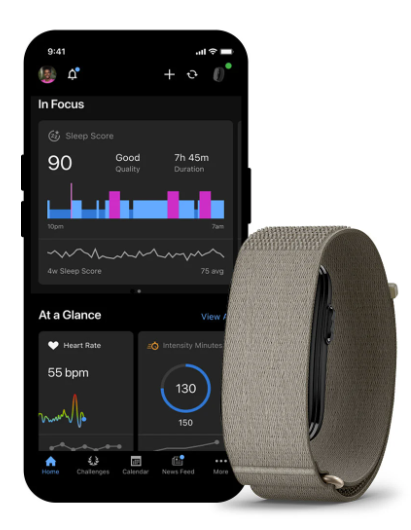
From sensors to action
When the Band and Smartphone Become a Productivity Bridge
The band stays close to the body and captures signals throughout the day. The smartphone application then transforms those signals into readable charts, scores, trends, and summaries. Together, they allow body data to move beyond the sensor and enter the process of reflection and decision-making.
Editorial position: this discussion is an independent review and is not sponsored, supported, or endorsed by Garmin or Google Fitbit.
Visual context
Two Approaches to Screenless Wearables
Garmin CIRQA and Google Fitbit Air illustrate how seemingly simple devices can provide all-day monitoring capabilities. They are shown to help readers understand the technological context, not as the result of product testing or as product recommendations.

Garmin CIRQA
A screenless health band focused on monitoring fitness, energy, stress, sleep, activity, and recovery.
View official product source ↗
Google Fitbit Air
A lightweight device for monitoring health, activity, sleep, and physical readiness within the Google Health ecosystem.
View official product source ↗Body data, however, is not the final objective. Thousands of numbers stored each day create little value when viewed only as statistics. Their value emerges when they help people make better decisions.
From Body Data to Productive Decisions
Wearable intelligence can help a person identify patterns between physical condition and work quality. Is insufficient sleep associated with reduced concentration? Does a particular work demand increase stress? Can light physical activity restore energy? At what time is a person most ready for work that requires deep thinking?
When body energy is high, strategic and creative work can be prioritized.
When physical readiness declines, lighter administrative tasks can be performed.
When stress increases, a recovery break can be taken before making an important decision.
When fatigue patterns persist, workload and working methods should be evaluated.
This approach does not mean that people should submit entirely to numbers. Technology serves as an aid to reflection, while decisions remain in human hands. Data indicates tendencies; people provide context, judgment, and meaning.
Its Relevance to Productivity 3.0
In Productivity 3.0, people are not treated as production machines that must remain constantly active. Productivity is understood as the capacity to create sustainable impact while considering human condition, capacity, and well-being.
Data records physical condition and activity continuously. Story emerges when data is read as patterns of life, habits, pressure, energy, and recovery. Impact emerges when those patterns are used to improve how people work, learn, rest, and make decisions.
The effectiveness of a wearable is not determined by the number of sensors or the price of the device, but by the human ability to transform data into awareness and behavioral change.
From Measuring Activity to Understanding People
A device may show that a person slept poorly, but people must still determine the cause and appropriate response. It may indicate increased stress, yet the work environment, responsibilities, and social conditions still require consideration. Wearables should therefore help people understand their condition, not judge them.
At the individual level, data can help regulate work and recovery rhythms. At the family level, it can encourage healthier habits. In education, it can help reveal learning readiness. In the workplace, ethically used aggregate data can support productivity and well-being policies.
Health data must not become an instrument of surveillance, coercion, or punishment. People must remain the decision-makers regarding their bodies and data.
Quiet Technology, Autonomous Human Beings
The future of productivity is not about people being controlled by technology. It is about people understanding themselves more deeply with the help of technology.
Wearable intelligence opens a path toward productivity that is more personal, adaptive, and sustainable. It helps shift the question from “how long do we work?” to “under what conditions can we create our best impact?”
This is the new direction of Productivity 3.0: not merely working more, but working with awareness, balance, and smarter decisions.
Coming next
Toward Series 2
This first series is a conceptual discussion and does not yet present the results of direct testing of any specific device.
In the forthcoming Series 2, a wearable will be used in a structured experiment to observe relationships among sleep, stress, energy, activity, focus, recovery, and daily productivity. The discussion will draw on actual usage data, reflective notes, and before-and-after evaluation of an adaptive work pattern.
Note: This article is educational and conceptual. It is not medical advice, paid advertising, or the result of testing Garmin CIRQA or Google Fitbit Air. Product names, images, and trademarks belong to their respective owners and are used as contextual references. Features may change; readers should consult official sources.